 Skip to content


You ran an indoor air quality test, and now you are looking at a list of numbers like 1,150 ppm, a humidity percentage, and a PM2.5 figure, with no clear sense of which one means trouble. Guess wrong and you either spend on equipment you do not need or shrug off a reading that genuinely matters. This guide walks each number one at a time.
Every indoor air quality test result has its own healthy range and its own meaning. CO2 climbing past around 1,000 ppm points to weak ventilation, relative humidity should sit between 30 and 50 percent, and PM2.5 and VOC readings flag airborne particles and off-gassing. A single high number is a flag to investigate, not a verdict, and several readings need no action at all once you know what normal looks like.
What Should Each Indoor Air Quality Test Reading Be?
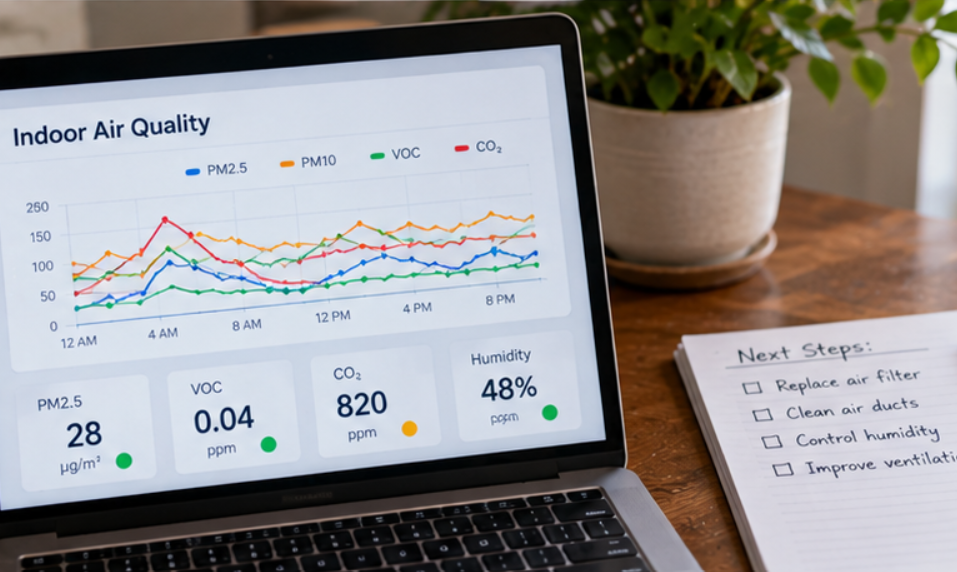
Before decoding any single number, it helps to see them side by side. The table below pairs each common reading with its healthy range and what it is actually telling you, so you can find the one you are worried about and know whether the rest are fine.
| Reading | Healthy range | What it tells you |
|---|---|---|
| CO2 | Below around 1,000 ppm | How well fresh air is reaching the room |
| Relative humidity | 30 to 50 percent | Mold and dust-mite risk, plus comfort |
| PM2.5 | Under about 9 µg/m³ averaged over a day | Fine particles from smoke, cooking, pollen |
| VOCs | Low band | Off-gassing from paint, cleaners, furniture |
| Carbon monoxide | 0 ppm; any steady reading needs a check | A combustion safety line, not a comfort number |
| Radon | Below 4 pCi/L | A soil gas that needs its own multi-day test |
Treat a single high reading as a flag to watch, not a diagnosis. The checklist further down shows how to confirm a number before you pay for any equipment.
One caution before you go further: most home air monitors do not measure carbon monoxide at all. A CO alarm on every level of the home and outside sleeping areas is the reading that protects you. Radon is the other outlier. It needs its own test kit over several days, and a result at or above 4 pCi/L, the EPA action level, calls for a certified radon mitigation specialist.
What Does a High CO2 Reading Tell You?
A high CO2 reading almost always means ventilation is lagging, not that the air is toxic. Carbon dioxide builds up as people breathe in an enclosed space, so the number works as a proxy for how much fresh air is actually exchanging with the room. Ventilation is simply that exchange: outdoor air coming in and stale indoor air leaving.
Outdoor air typically sits near a baseline of roughly 400 to 420 ppm, and that is the floor your indoor reading climbs up from. Once the number pushes past around 1,000 ppm, it usually signals that fresh-air exchange is falling behind the number of people in the space. The fix is rarely complicated: open a door, crack a window, or run your system’s fresh-air ventilation if it has one, such as an ERV or HRV.
Newer, tighter builds complicate this. A well-sealed home that loses little air to leaks lets CO2 climb faster, and the same thing happens in winter when everything is shut up against the cold. That does not mean the house is unsafe. It means the reading is doing its job, telling you the room needs more air than it is getting. A high CO2 number is also one of the most common reasons behind a house that feels stuffy even when the thermostat says the temperature is fine.
What Do Your Humidity Readings Mean?
The EPA recommends indoor relative humidity between 30 and 50 percent, a range that holds down both mold and dust mites. Relative humidity is the share of moisture the air holds against what it could hold at that temperature, making it the single number that tracks dampness.
Dust mites thrive once readings stay above 50 percent, and mold gets a foothold when they hold above about 60 percent; below 30 percent brings dry air, static, and irritated sinuses. The harder question is whether a high reading is a leak or just weather, since humid Mid-Atlantic summers routinely push even well-kept Beltsville homes above the band.
A high reading on a muggy July afternoon is often the climate working through your walls, not a hidden pipe or roof problem. That distinction decides your fix: if high humidity tracks with the season and clears when the weather breaks, a dehumidifier handles it.
But if a single room reads high year-round, or you see staining and smell must, that points to a moisture source worth hunting down before mold takes hold. Sustained dampness is the true risk behind the number, which is why humidity deserves closer watching than a one-time spike.
Winter flips the problem. Once the heat runs steadily, many DMV homes drop below 30 percent, and a whole-home humidifier brings the number back into range without a row of tabletop units.
What Do PM2.5 and Particle Readings Mean?
PM2.5 measures fine particles small enough to reach deep into your lungs, and the sources split between inside your home and outside it. Reading this number well means figuring out which side it came from, because the fix is completely different depending on the answer.
How High Is Too High for PM2.5?
Lower is always better, and PM2.5 has no safe floor the way CO2 has a baseline. A brief rise while you sear a steak is expected and clears within the hour. What should prompt action is a reading that stays elevated with no obvious cause, or one that climbs and holds for hours. A sustained figure is the signal; a short cooking spike is not.
What Causes an Indoor Particle Spike?
Cooking is the most common indoor source, especially frying and high-heat searing, followed by candles, fireplaces, and vacuuming without a sealed filter. These show up as sharp peaks that fall once the activity stops and the air clears. If your number spikes at dinnertime and settles by bedtime, you have found your source and there is nothing to fix beyond running the range hood.
How a Filter’s MERV Rating Changes the Reading
A filter’s MERV rating, short for Minimum Efficiency Reporting Value, tells you how small a particle it can trap, and higher numbers catch progressively finer ones. Residential filters in the MERV 11 to 13 range start capturing fine particulates that lower-rated filters pass straight through. Moving up to that range can noticeably lower a persistent PM2.5 reading, though your blower and ductwork have to tolerate the added resistance.
When a Portable HEPA Unit Makes Sense
When ducted filtration cannot go high enough without choking airflow, a portable HEPA unit is the alternative. HEPA filtration captures the vast majority of fine particles in a single pass, and a unit sized for the room gives you targeted control in a bedroom or office. It is the practical answer when you want cleaner air in one space without re-engineering the whole system.
How to Read Particles on a Smoke or Pollen Day
Wildfire smoke carried in from distant fires, along with heavy spring pollen, can spike outdoor particulates that then register on your indoor monitor. On those days, a high PM2.5 reading points outside, not in. The fix is to keep windows shut, run filtration, and wait it out, so improving your home’s overall air quality through better filtration pays off most exactly when the outdoor air turns bad.
What Do VOC and Combustion Readings Mean?
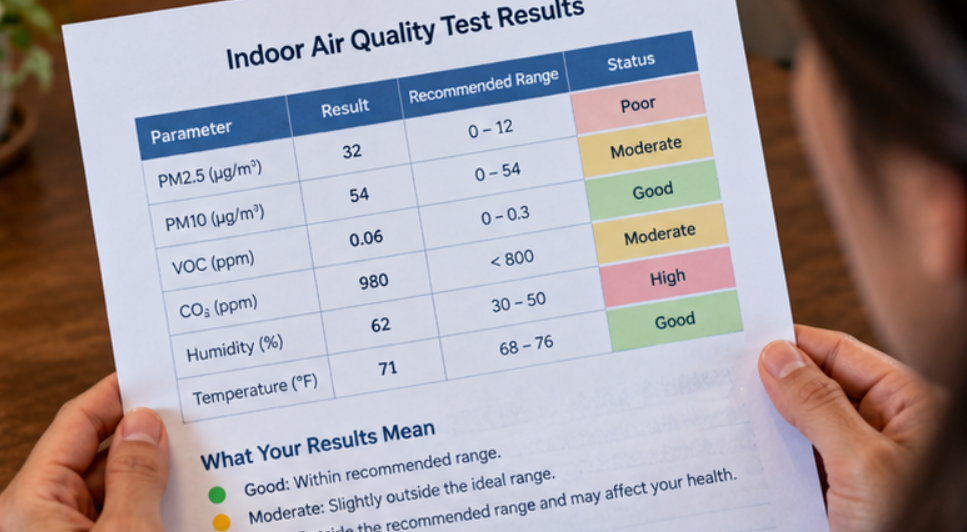
VOCs, or volatile organic compounds, are gases that off-gas from everyday household materials, and consumer monitors usually report them in broad low, moderate, and high bands instead of exact numbers. A spike is normal after certain activities and fades on its own; a reading that stays elevated for days is the one worth chasing to its source.
Common VOC sources a reading may be picking up:
- Fresh paint and finishes: New paint, varnish, and sealants off-gas heavily for days, then taper off.
- Cleaning products: Aerosols and strong solvents push the reading up briefly during and after use.
- New furniture and flooring: Pressed-wood and synthetic materials release VOCs for weeks after install.
- Air fresheners and candles: Scented products add VOCs continuously while they are in use.
- Stored solvents: Open containers of paint thinner or fuel in a garage can register indoors.
Combustion readings are a different category entirely. Carbon monoxide and other combustion byproducts are not a comfort metric; any meaningful presence is a safety line, and that is where a monitor stops being enough. A VOC spike after painting clears with ventilation, but a combustion reading on an appliance you heat or cook with needs a licensed professional before you run that equipment again. If a carbon monoxide alarm sounds, or anyone in the house feels headachy, dizzy or sick, get everyone outside right away and call 911 from outside. If you smell gas, leave first and call your gas utility or 911 once you are out.
Should You Worry About One High Reading?
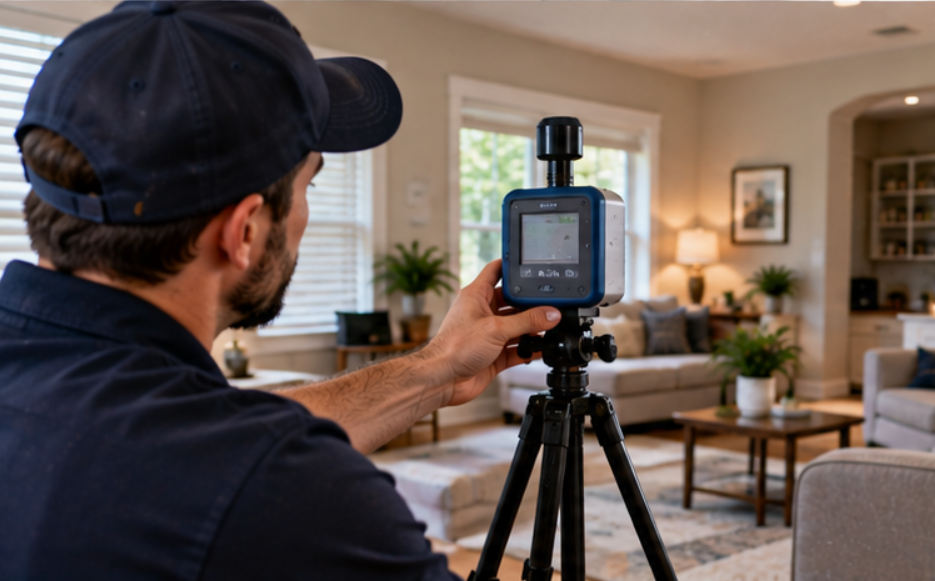
A single reading is a snapshot, and snapshots mislead. Low-cost home monitors are good at showing trends but are not laboratory-accurate, and the EPA notes these monitors measure only specific contaminants under limited conditions. One number taken once tells you far less than the same number tracked across several days.
Before you act on any alarming result, work through this:
- Re-test at the same time: Take the reading at a consistent time of day so you compare like with like.
- Note what you were doing: Cooking, cleaning, or a closed room explains most short spikes.
- Watch the trend, not the peak: A number that keeps climbing matters more than one that briefly jumps.
- Check the weather and outdoor air: Smoke and pollen days move indoor particles from outside.
- Confirm nothing is normal: Many readings land in the healthy range and need no fix at all.
Some perspective helps here. According to the EPA, indoor levels of some pollutants often run 2 to 5 times higher than outdoor levels, so a number above the outdoor baseline is common rather than alarming. When the trend genuinely stays high, a professional indoor air quality test looks at the whole house over time, which is what separates a genuine problem from a noisy monitor.
With each number decoded, the readings that actually call for action come down to two kinds: any number that stays high for days, especially humidity above 60 percent, and any combustion reading at all. Everything else is usually something you can watch, adjust, or leave alone once you understand what the number is telling you.
Why Choose Fortiz HVAC Inc. for Indoor Air Quality in Beltsville?
Fortiz HVAC Inc. is a family-owned team based in Beltsville, with technicians licensed in Maryland, DC, and Virginia. When a home monitor leaves you unsure, a second set of numbers taken with professional meters settles whether a reading needs action.
Our assessment covers humidity, CO2, particles, VOCs, and carbon monoxide around every fuel-burning appliance, in the rooms you actually use. You get the results in plain English, along with what each number means for your home and which ones can be left alone.
If your humidity keeps running high or a combustion reading has you unsure, call (240) 573-6584 or send us a message to book an indoor air quality test. If the results point to equipment like a dehumidifier or an ERV, financing through Wisetack can spread the cost.
Frequently Asked Questions
Is a CO2 reading of 1,000 ppm dangerous?
Not dangerous at that level, but it signals your ventilation is not keeping up. It usually means a closed room with several people in it and little fresh air coming in. Opening a door or running the system’s fresh-air exchange typically brings the number back down within minutes.
Why does my humidity read high even with the AC running?
In humid Mid-Atlantic summers the air carries a heavy moisture load, and an oversized or short-cycling AC cools the room quickly without running long enough to pull that moisture out. A dedicated dehumidifier often solves what the AC alone cannot, since it targets humidity directly instead of as a side effect of cooling.
What VOC level indoors is considered safe?
Consumer monitors report VOCs in broad low, moderate, and high bands rather than precise thresholds. A spike after painting, cleaning, or new furniture is expected and fades with ventilation. A reading that stays elevated for days, with no recent project to explain it, warrants tracking down the source.
Can I trust the numbers from an inexpensive home air monitor?
They are useful for trends but not lab-grade. Readings drift with sensor age, placement, and humidity, and most units track only a handful of pollutants. Watch how a number moves over several days instead of reacting to one reading. When a trend holds high, a professional test confirms what the monitor is hinting at.
How often should I retest my indoor air quality?
Retest whenever something changes: new flooring, a renovation, persistent symptoms, or after you have addressed an earlier problem and want to confirm it worked. For ongoing tracking, a continuous monitor beats occasional one-off tests, since it shows how your numbers move across days and seasons.


